From Trial to Business as Usual: A Decade of Fleet Electrification
Powerco began electrifying its fleet in 2016 to understand how EV charging would affect both operations and the electricity network. Starting with three vehicles, the company used telematics, staff engagement and staged infrastructure investment to guide a gradual transition.
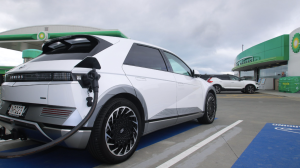
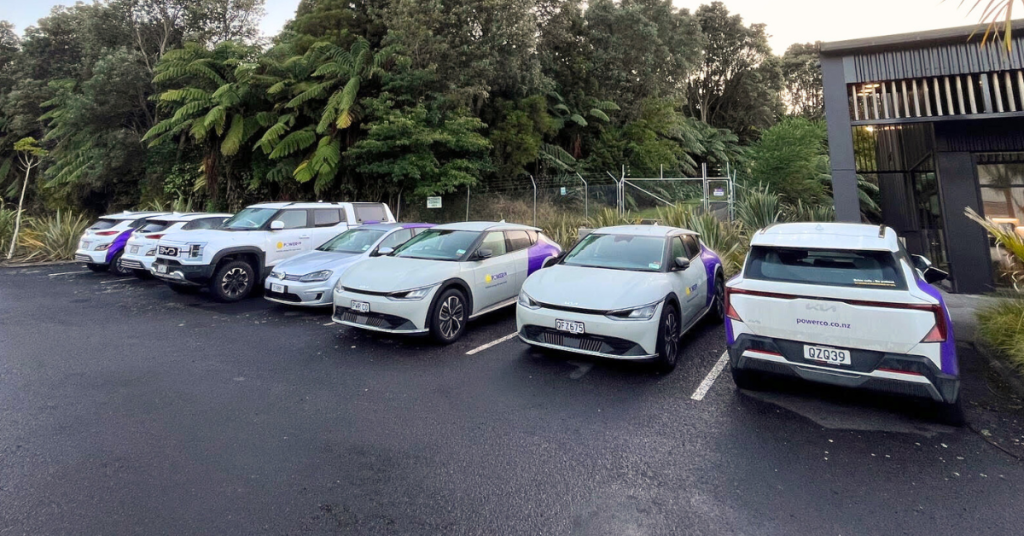
By 2025, the pool fleet was fully electric, exceeding the original 30 percent electrification target. Battery electric vehicles (BEVs) now meet most inter-office travel needs, supported by office-based charging and public fast charging for longer regional trips.
Fleet and charging data is helping to inform network planning and future demand. Staff buy-in has been strong, supported by demonstration days, clear information and hands-on experience.
Powerco’s approach shows that data-led, staged electrification can reduce costs, strengthen operations and prepare energy infrastructure for large-scale EV adoption.
In this Meet the Fleet, Powerco’s Dave Circuitt, Head of Corporate Property, and Eric Pellicer, General Manager Strategy, share highlights from a decade-long fleet transition.
Start Small, Learn Fast
In 2016, Powerco began with a simple trial: one Mitsubishi Outlander plug-in hybrid (PHEV) and two battery electric (BEV) Volkswagen e-Golfs as pool vehicles in New Plymouth.
The focus was on learning, not scale. Daily use allowed the fleet team to understand charging behaviour, vehicle range and network impacts, while building staff confidence.
Build Momentum
Early hesitation was expected due to unfamiliarity with the technology. Education, familiarisation, and hands-on experience quickly shifted attitudes.
An inclusive vehicle selection process, where employees described the requirments of their roles, helped build trust and strong EV buy-in. The fleet team worked closely with dealerships to run on-site events where staff could test drive vehicles and ask practical questions.
“The key for us has been providing information and education about the vehicles. On-site test drives and direct access to the fleet team and dealership representatives worked well to build good buy-in,” said Mr Circuitt.
Because most EVs were introduced as pool vehicles, many staff had the opportunity to use them. “The feedback has been positive. They’ve shown a keen interest in the new technology,” said Mr Pellicer.
As the fleet evolved, more electric hybrid vehicles were introduced. While models such as the Hyundai Ioniqs had joined the line-up, operational realities remained. Field crews working in remote and rugged locations required utes with long range and towing capability. As a provider of essential services, Powerco could not immediately move to a fully electric fleet. A staged, role-based transition was adopted.
From Trial to Business as Usual
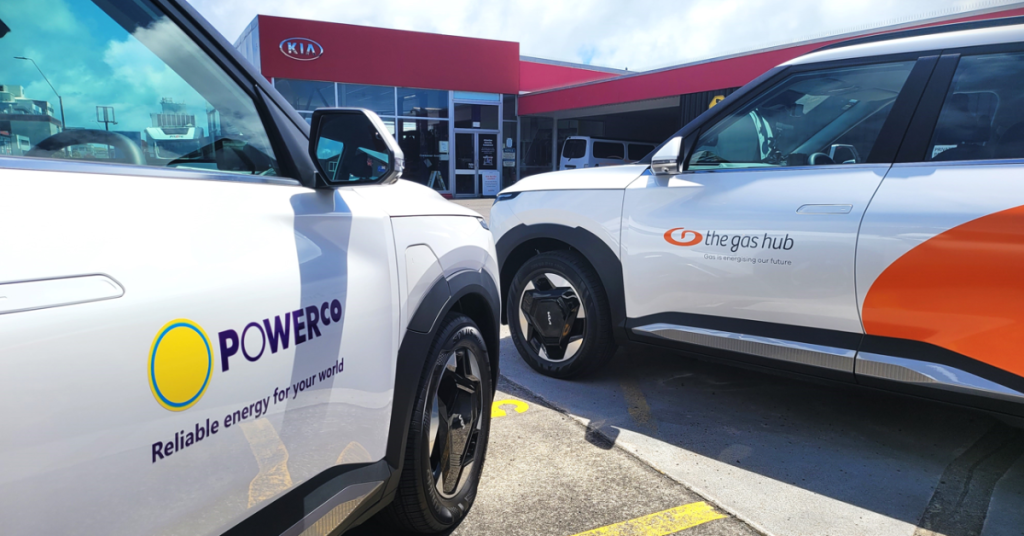
By April 2025, Powerco had exceeded its original electrification target. The pool fleet is now fully electric and primarily used for inter-office travel, including journeys of 300–350 km.
KIA EV6 and EV5 models were selected for their real-world range and strong dealer support, typically completing these trips with up to 150 km remaining.
BEVs have “…now become the norm for pool vehicle travel. Employees have been fantastic, and their buy-in has been truly impressive,” said Mr Circuit.
EVs are frequently booked, reflecting strong demand across the business, and many staff now drive EVs privately.
Data-Driven Decisions
Telematics has supported road user charges (RUC) compliance, safety and fleet optimisation. It has been pivotal in understanding vehicle utilisation and identifying practical opportunities to shift the fleet mix.
“The data made it clear that there were viable alternatives to internal combustion engine (ICE) vehicles. As a result, we have fully electrified our pool fleet across the business and have recently begun transitioning some of our allocated vehicles to electric as well,” said Mr Circuitt.
Fleet data showed most pool trips were well within BEV range and vehicles often returned to base overnight, confirming operational suitability. For longer trips requiring an overnight stay, hotel charging, public charging or office charging, were available and used. This strengthened the business case and secured leadership support, even when early EV purchase costs were higher than ICE vehicles.
Powerco partnered with Carbn to analyse fleet data and identify the most effective replacement pathway. Charging data has also been used to model future electricity demand and inform network planning.
Recognising this as a long-term process, Powerco has taken a measured approach, aligning change with lease cycles and operational needs.
How has Powerco Overcome Common EV Transition Barriers?
Higher upfront costs
In 2016 the purchase and lease cost of BEVs was significantly higher than comparable ICE vehicles. Powerco secured senior leadership support by developing a strong long-term business case based on whole-of-life costs, including fuel, maintenance and charging infrastructure. As vehicle prices have fallen and operating costs proven lower, the financial case has strengthened.
Limited vehicle choice
Early EV options did not suit all roles. Powerco prioritised pool and urban vehicles while retaining hybrid and ICE vehicles where operationally necessary. As vehicle range and capability have improved, KIA models were selected for most pool vehicles. Remaining ICE vehicles will be reviewed as new hybrid and electric ute options come to market, with decisions based on suitability for Powerco.
Employee hesitance
Early hesitation was expected and addressed through demonstration days, test drives and direct access to the fleet team and suppliers. This open, supportive approach normalised EV use and built confidence. Identifying EV champions across teams further strengthened momentum.
Lessons in Charging
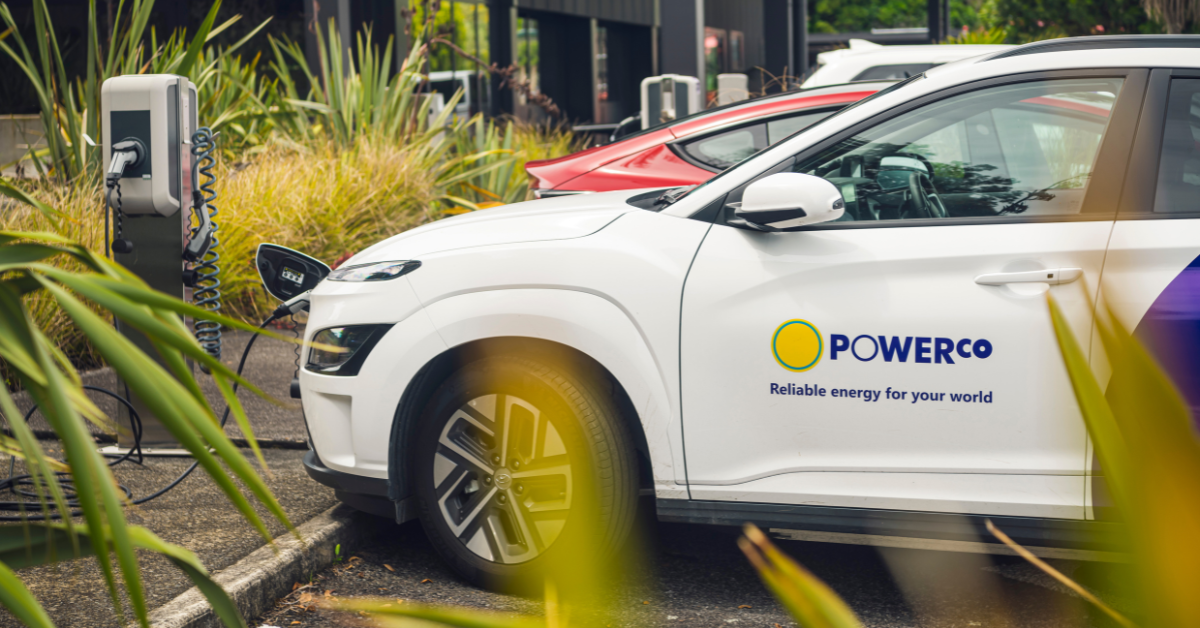
Most charging occurs overnight at Powerco offices using 7 kW Wallbox chargers, aligining with typical vehicle utilisation patterns and allowing vehicles to be reliably replenished during off-peak periods. This approach maximises charger availability while minimising impact on site demand during business hours.
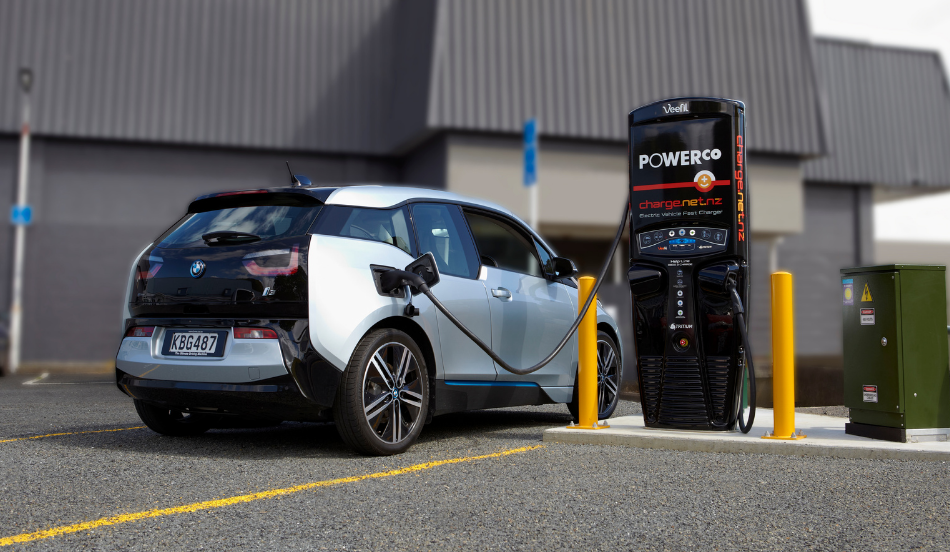
A 60 kW Wallbox fast charger has been installed at the New Plymouth site office, providing rapid top-ups for high-use and pool vehicles with quick turnaround requirements, as well as supporting visitors and operational flexibility during the day. This has reduced reliance on public infrastructure for urgent charging needs and improved overall fleet availability.
Home chargers have also been installed for some allocated vehicles, enabling convenient overnight charging and reducing pressure on workplace infrastructure. This has proven particularly effective for staff with consistent vehicle allocation and regular travel patterns, while also supporting business continuity outside of standard operating locations.
In addition, a shared staff EV charger has been installed to support employees who require a small top-up charge to comfortably complete their journey home. This time-limited option provides a practical and equitable solution, helping to encourage EV adoption among staff while supporting those already transitioning to electric vehicles.
Together, this mix of overnight workplace charging, targeted fast-charging capability, selective home charging, and staff support infrastructure provides a balanced and scalable approach that meets operational needs while reinforcing broader EV uptake.
Benefits Beyond Lower Emissions
Electrifying the fleet has delivered benefits well beyond emissions reduction.
Operationally, fuel and servicing costs have decreased while vehicle performance across regions remains strong.
Culturally, staff satisfaction is high, with many employees choosing to adopt EVs privately.
Strategically, fleet and charging data is helping Powerco build a better understanding of future electricity demand.
Leading by Example for the Network
As Aotearoa New Zealand’s largest electricity distribution business by network length, Powerco recognises that fleet electrification is only part of the picture. Preparing the network for widespread EV adoption is equally important.
In partnership with ChargeNet, Powerco has supported the increase of public chargers across the Bay of Plenty, Coromandel, Wairarapa, Manawatū, Taranaki and Whanganui. These installations support both community EV uptake and staff travelling between regional offices.
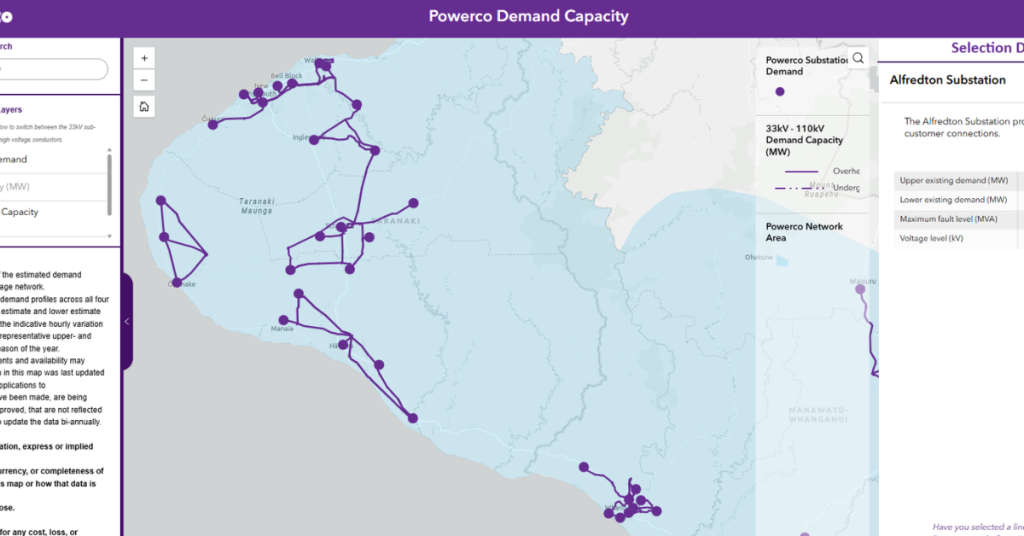
Beyond infrastructure delivery, Powerco enables others to connect with confidence. The company publishes demand capacity maps showing available capacity on its high-voltage network. This allows charge point operators (CPOs) and large customers assess connection feasibility early, using the maps as a pre-screening step before progressing projects.
Powerco’s fleet data and charging trials inform network design, load forecasting and upgrade planning. Community initiatives, including providing an EV and charging station to a Taranaki Māori health provider, have generated valuable operational data while delivering local benefit.
As EV uptake increases, so too does electricity demand, particularly from residential charging. Ensuring the network can accommodate this growth is central to Powerco’s planning.
“We’re intent on preparing the electricity network for our customers to ensure it is ready for the inevitable transition to electric vehicles,” Mr Pellicer says.
Through practical trials, strategic partnerships and transparent planning tools, Powerco is helping ensure its regions are prepared for large-scale EV growth while demonstrating how distribution businesses can support the transition responsibly and proactively.
What Next?
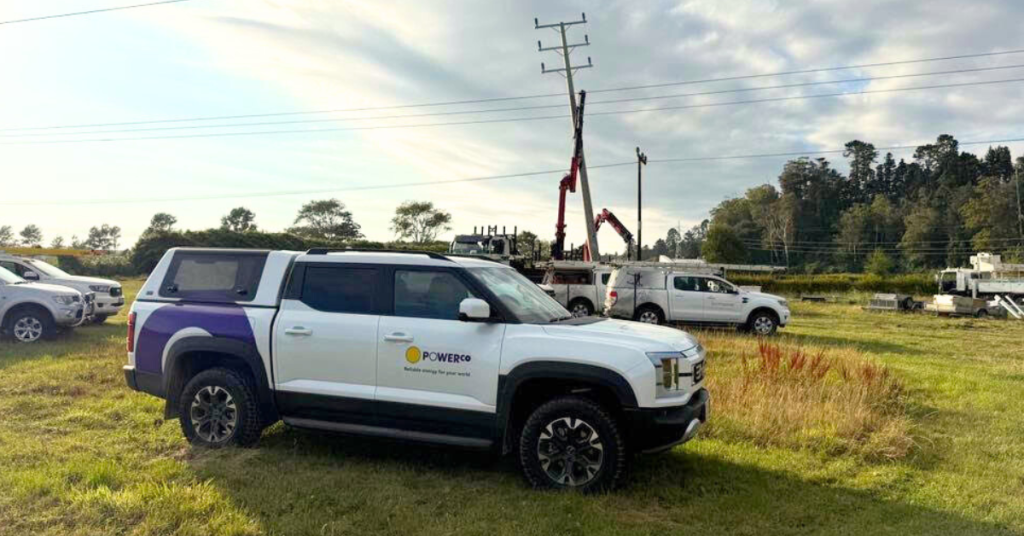
Powerco’s next goal is to reduce the remaining full ICE vehicles from its fleet. With new BEV options entering the market, the focus is on selecting fit-for-purpose that meet performance, capability, safety and range requirements.
For Powerco, fleet electrification is not simply a transport decision. It is part of preparing Aotearoa’s energy system for the future. By learning through its own operations, the company is helping ensure the electricity network is ready for widespread EV uptake while reducing emissions and operating costs today.
About Powerco
Powerco is Aotearoa New Zealand’s largest dual-energy distributor by network length, connecting more than a million Kiwis across the North Island to safe, reliable gas and electricity.
With over 29,200 km of electricity lines and 6,200 km of gas pipelines, the company plays a critical role in powering homes, businesses and industries.
Electrifying its own fleet is one way Powerco is preparing both its operations and its network for a low-emissions future.
Learn more about Powerco’s EV infrastructure.